

By Gerome Dalipe IV
For 13,441 aspiring lawyers, the long wait is over—but the real test is just beginning.
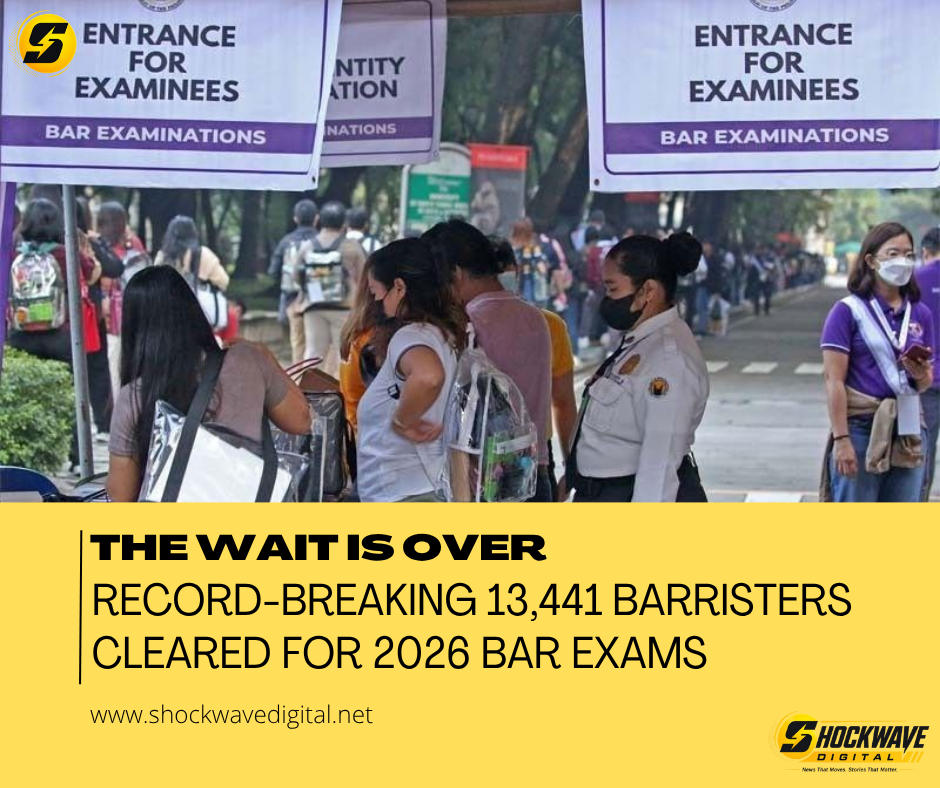
The Supreme Court’s Office of the Bar Confidant (OBC) has cleared 13,441 of the 14,291 applicants to take the 2026 Bar Examinations, marking the biggest pool of registered applicants in the history of the country’s most dreaded professional examination.
The number surpasses the 13,193 who registered for the 2025 Bar Exams, although only 11,425 ultimately completed the examinations that year.
This year’s Bar Exams will be held on September 6, 9 and 13 at 15 testing centers nationwide, with San Beda College Alabang in Muntinlupa City serving as the National Headquarters.
Supreme Court Associate Justice Samuel Gaerlan chairs the 2026 Bar Examinations.
In the Visayas, Central Philippine University (CPU) in Iloilo City has been designated as one of the local testing centers. Hundreds of barristers from CPU, the University of San Agustin, West Visayas State University and nearby provincial law schools are expected to converge at the university for the three-day examination.
The six core areas remain the battleground: Political and Public International Law, 15%; Commercial and Taxation Laws, 20%; Civil Law and Land Titles and Deeds, 20%; Labor Law and Social Legislation, 10%; Criminal Law, 10%; and Remedial Law, Legal and Judicial Ethics, with Practical Exercises, 25%.
But beyond the percentages, codal provisions and jurisprudence lies a much more personal struggle.
The Bar has long been regarded as one of the most difficult professional examinations in the country—a test not only of what a barrister knows, but of how well that knowledge can withstand pressure.
Ralph A. Sarmiento, dean of the University of St. La Salle College of Law in Bacolod City, described the experience as putting a barrister’s entire being, personality and dignity on the line.
“People, who know you and whom you know, as well as your friends and enemies alike, would be on close watch, eagerly waiting to see you succeed or fail, earnestly waiting to join you in your celebration or to laugh at you in your defeat,” Sarmiento wrote in his blog, Bar Exam Tips, Secret, Techniques, & Strategies.
Then comes what many law graduates call “Judgment Day”—the release of the results.
“It separates the sheep from the goats. It brings out tears of joy to some and tears of frustration, sadness, and grief to others. Taking the Bar Exam is therefore a serious matter. Much is at stake,” Sarmiento stressed.
THE THREE Ls
So why do some barristers make it while others fall short?
Sarmiento points to three essential weapons: Logic, Language and Law.
The first two, he said, should already be part of a student’s arsenal before entering law school. The third is developed through years of legal education.
“Most of the reasons for flunking the Bar Exams are related to these three L’s. People who flunk have problems in one, in two, or all the three L’s,” Sarmiento said.
A weakness in Logic may surface through misappreciation of facts and issues, poor analysis, faulty reasoning or conclusions that are not supported by the evidence.
Language, meanwhile, can become a stumbling block through grammatical errors, poorly structured sentences, misspelled words and weak written communication.
Then there is Law itself—the failure to know the applicable legal principles, understand them fully, recognize outdated legal knowledge or properly apply the law and jurisprudence to a given set of facts.
But those are not the only reasons examinees fail.
Inadequate preparation, health concerns and emotional difficulties can also derail months or even years of hard work.
That is why, Sarmiento said, preparation must be deliberate.
“Preparation is the key to success in the Bar Exam. But this is not just any kind of preparation. You must have a game plan and you should stick to it as if your entire life depends on it,” he emphasized.
STUDY SMART, NOT JUST HARD
The first step is knowing where one stands.
Sarmiento advises barristers to identify their strongest and weakest subjects before plunging into intensive review.
“Evaluate your performance on each of the eight Bar subjects. Your transcript of law school records can give you a more or less objective evaluation of your performance. Examine your transcript of records and compute your grade average on each of the eight Bar subjects,” he said.
Review time should then be distributed according to the weight of each subject, while taking into account which areas an examinee personally finds most difficult.
“More review time should be allocated to morning subjects, especially to Remedial Law, but make some adjustments on subjects that you perceive to be more difficult than the others,” Sarmiento said.
A complete inventory of books, reviewers and other study materials is also essential to make sure no major subject or topic is left uncovered.
But Bar preparation, he cautioned, is no longer law school.
“You no longer study to survive the horrifying graded recitations. The Bar Exams are not only about what you have remembered or what you can recite. It tests more than mere memory and understanding. It tests your ability to analyze legal problems and to apply relevant laws and jurisprudence,” he stressed.
In other words, studying harder is not necessarily the answer.
Barristers must study smarter—prioritizing important and relevant topics instead of spending precious hours wrestling with questions that are, as Sarmiento puts it, “out of this world.”
Legal provisions should likewise be organized into categories, allowing examinees to manage the enormous volume of information they have accumulated throughout law school.
TRAIN FOR THE REAL THING
There is another part of preparation that cannot be simulated through ordinary reading: endurance.
Sarmiento recommends taking full-length practice examinations under actual exam conditions.
That means answering a complete Bar questionnaire in one four-hour stretch, or tackling two Bar subjects for a total of seven hours in a single day.
“See if your writing hand and fingers can survive seven hours of punishment. See if you can manage to answer without having to answer the call of nature. Evaluate your mental and physical readiness for this kind of exam,” he said.
He also reminded barristers of the three Cs in studying law: codal provisions, commentaries and cases.
Codal provisions, he stressed, should never be taken for granted. They should form the foundation, followed by commentaries and relevant jurisprudence.
And while the Bar is unquestionably a test of legal knowledge and analytical ability, Sarmiento said examinees cannot afford to neglect the body and mind carrying them through those three grueling days.
“Keep a healthy lifestyle throughout the review period and the Bar Exam month. Get enough sleep. Eat nourishing meals. Exercise to keep your body and mind sharp,” he advised.
For the 13,441 barristers cleared to take this year’s exams, the countdown has become real.
Three examination days. Six core areas. Years of preparation compressed into hours of writing, analysis and judgment.
And at the end of it all, one result that can change a life.